
Your one-stop destination to learn about Prop Firms, Forex, Binary Options, and Cryptocurrency.
Chapter 3: Technical Analysis for Binary Options Trading
Page Contents:
1- Candlestick charts and Candlestick Patterns
2- Support and resistance levels or Supply and Demand Zones
5- Indicators (RSI, MACD, etc.)
CLICK HERE FOR: Chapter 4: Fundamental Analysis for Binary Options Trading.

What are Candlestick charts ?
Candlestick charts are a popular type of chart used in financial markets, including binary options trading. They provide traders with a visual representation of the price movements of an asset over a specific period of time. In this article, we will explore what candlestick charts are, how they are used, and some common candlestick patterns.
What are Candlestick Charts ?
Candlestick charts are a type of chart used to display the price movements of an asset over a specific time period, such as one minute, one hour, or one day. Each candlestick on the chart represents a single period, and consists of a rectangular body and two lines, called "shadows" or "wicks". The body represents the opening and closing prices of the asset, while the shadows represent the highest and lowest prices for that period.
Candlestick charts are used to provide traders with a more detailed view of price movements compared to other chart types, such as line charts or bar charts. They are also easier to read and interpret, allowing traders to quickly identify key patterns and trends in the market.
How are Candlestick Charts Used in Trading ?
Candlestick charts are used in technical analysis to identify patterns and trends in the market, which can help traders make better trading decisions. By analyzing the shape and position of the candlesticks on the chart, traders can determine whether the market is trending up or down, or if it is moving sideways.
Traders also use candlestick charts to identify potential price reversals or trend continuations. For example, a bullish candlestick pattern may indicate that the price is likely to continue to rise, while a bearish pattern may indicate that the price is likely to fall.
Using Candlestick Charts in Binary Options Trading
Candlestick charts are used in binary options trading in several ways, such as:
-
Identifying Market Trends - Candlestick charts allow traders to identify market trends by observing the overall direction of the price movements over a specific period. This information can help traders determine whether to buy or sell an asset.
-
Analyzing Price Patterns - Candlestick charts help traders identify various price patterns that can indicate potential trading opportunities. For example, a Doji pattern indicates indecision in the market and can signal a potential reversal.
-
Determining Support and Resistance Levels - Candlestick charts can help traders identify support and resistance levels, which are price points where the asset is likely to experience increased buying or selling pressure. These levels can be used to determine entry and exit points for trades.
-
Assessing Market Sentiment - Candlestick charts can provide valuable insights into market sentiment, allowing traders to gauge whether buyers or sellers are in control of the market.
In conclusion candlestick charts are a valuable tool for binary options traders, providing a visual representation of price movements over a specific time period. By identifying key patterns and trends in the market, traders can make more informed trading decisions and potentially increase their profits. However, it is important to remember that no trading strategy is foolproof, and traders should always do their own research and exercise caution when investing in the financial markets.
Bullish CandleStick

High
Close
Open
Low
Bearish CandleStick

High
Open
Close
Low
Introduction to Different Candlestick Patterns
Candlestick charting is a powerful tool for analyzing price movements in the financial markets. By studying the shape, color, and placement of candlesticks on a price chart, traders can gain valuable insights into market trends and make informed trading decisions.
There are many different candlestick patterns, each with its own unique characteristics and applications. Some patterns, like the Bullish Engulfing and the Morning Star, signal a potential trend reversal or a change in market sentiment. Others, like the Hammer and the Inverted Hammer, suggest that buyers are stepping in to support a falling market.
Still, other patterns, like the Doji and the Long-Legged Doji, indicate indecision in the market and can be used as a signal to wait for further confirmation before taking a position. And some patterns, like the Three White Soldiers and the Three Black Crows, suggest that the market is moving strongly in one direction.
At the end of the day, understanding candlestick patterns is essential for any trader looking to gain an edge in the financial markets. By incorporating candlestick analysis into your trading strategy, you can increase your chances of success and improve your overall profitability.
Bullish Engulfing Pattern

-
The bullish engulfing pattern is a candlestick pattern that occurs in a downtrend and suggests a potential reversal to an uptrend.
-
The pattern consists of two candlesticks, with the first candlestick being a red (or bearish) candlestick and the second candlestick being a green (or bullish) candlestick.
-
The green candlestick completely engulfs the red candlestick, with the opening price of the green candlestick below the closing price of the red candlestick and the closing price of the green candlestick above the opening price of the red candlestick.
-
The bullish engulfing pattern indicates that buyers have taken control of the market and are pushing the price higher.
-
The pattern can be a strong signal of a potential trend reversal, but it's important to confirm the pattern with other technical indicators and market analysis.
-
Some traders use the bullish engulfing pattern as a buy signal, placing a long position with a stop loss below the low of the red candlestick and a profit target based on the potential length of the uptrend.
-
Traders should also consider the overall market context and fundamental factors that may be influencing the price action, as well as any potential risks or uncertainties that could impact the trade.
Overall, the bullish engulfing pattern is a popular candlestick pattern among traders, as it can provide valuable insights into potential trend reversals and opportunities for profitable trades. However, it's important to use the pattern in conjunction with other technical indicators and market analysis, and to always consider the potential risks and uncertainties of the trade.
Bearish Engulfing Pattern

-
The bearish engulfing pattern is a candlestick pattern that occurs in an uptrend and suggests a potential reversal to a downtrend.
-
The pattern consists of two candlesticks, with the first candlestick being a green (or bullish) candlestick and the second candlestick being a red (or bearish) candlestick.
-
The red candlestick completely engulfs the green candlestick, with the opening price of the red candlestick above the closing price of the green candlestick and the closing price of the red candlestick below the opening price of the green candlestick.
-
The bearish engulfing pattern indicates that sellers have taken control of the market and are pushing the price lower.
-
The pattern can be a strong signal of a potential trend reversal, but it's important to confirm the pattern with other technical indicators and market analysis.
-
Some traders use the bearish engulfing pattern as a sell signal, placing a short position with a stop loss above the high of the green candlestick and a profit target based on the potential length of the downtrend.
-
Traders should also consider the overall market context and fundamental factors that may be influencing the price action, as well as any potential risks or uncertainties that could impact the trade.
Overall, the bearish engulfing pattern is a popular candlestick pattern among traders, as it can provide valuable insights into potential trend reversals and opportunities for profitable trades. However, it's important to use the pattern in conjunction with other technical indicators and market analysis, and to always consider the potential risks and uncertainties of the trade.
Inverted Hammer Pattern

-
The inverted hammer pattern is a single candlestick pattern that can occur in both uptrends and downtrends, but is most commonly seen in downtrends.
-
The pattern consists of a candlestick with a small body and a long upper shadow, and little to no lower shadow.
-
The opening price of the candlestick is typically similar to the closing price, with most of the trading activity occurring near the high of the candlestick.
-
The inverted hammer pattern suggests that buyers have attempted to push the price higher, but were ultimately unsuccessful in sustaining the upward momentum.
-
The pattern can be a signal of a potential trend reversal, particularly if it occurs after a prolonged downtrend or in conjunction with other technical indicators and market analysis.
-
Some traders may use the inverted hammer pattern as a buy signal, placing a long position with a stop loss below the low of the candlestick and a profit target based on the potential length of the uptrend.
-
Traders should also consider the overall market context and fundamental factors that may be influencing the price action, as well as any potential risks or uncertainties that could impact the trade.
Overall, the inverted hammer pattern is a candlestick pattern that can provide valuable insights into potential trend reversals and opportunities for profitable trades. However, like any technical analysis tool, it should be used in conjunction with other indicators and market analysis to make informed trading decisions.
Shooting Star Pattern
-
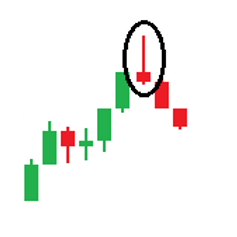
The shooting star pattern is a single candlestick pattern that can occur in both uptrends and downtrends, but is most commonly seen in uptrends.
-
The pattern consists of a candlestick with a small body and a long upper shadow, and little to no lower shadow.
-
The opening price of the candlestick is typically similar to the closing price, with most of the trading activity occurring near the high of the candlestick.
-
The shooting star pattern suggests that sellers have attempted to push the price lower, but were ultimately unsuccessful in sustaining the downward momentum.
-
The pattern can be a signal of a potential trend reversal, particularly if it occurs after a prolonged uptrend or in conjunction with other technical indicators and market analysis.
-
Some traders may use the shooting star pattern as a sell signal, placing a short position with a stop loss above the high of the candlestick and a profit target based on the potential length of the downtrend.
-
Traders should also consider the overall market context and fundamental factors that may be influencing the price action, as well as any potential risks or uncertainties that could impact the trade.
Overall, the shooting star pattern is a candlestick pattern that can provide valuable insights into potential trend reversals and opportunities for profitable trades. However, like any technical analysis tool, it should be used in conjunction with other indicators and market analysis to make informed trading decisions.
Hammer Pattern

-
The hammer pattern is a single candlestick pattern that can occur in both uptrends and downtrends, but is most commonly seen in downtrends.
-
The pattern consists of a candlestick with a small body and a long lower shadow, and little to no upper shadow.
-
The opening price of the candlestick is typically similar to the closing price, with most of the trading activity occurring near the low of the candlestick.
-
The hammer pattern suggests that buyers have attempted to push the price higher, and were successful in reversing the downward momentum.
-
The pattern can be a signal of a potential trend reversal, particularly if it occurs after a prolonged downtrend or in conjunction with other technical indicators and market analysis.
-
Some traders may use the hammer pattern as a buy signal, placing a long position with a stop loss below the low of the candlestick and a profit target based on the potential length of the uptrend.
-
Traders should also consider the overall market context and fundamental factors that may be influencing the price action, as well as any potential risks or uncertainties that could impact the trade.
Overall, the hammer pattern is a candlestick pattern that can provide valuable insights into potential trend reversals and opportunities for profitable trades. However, like any technical analysis tool, it should be used in conjunction with other indicators and market analysis to make informed trading decisions.
Hanging Man Pattern

-
The hanging man pattern is a single candlestick pattern that can occur in both uptrends and downtrends, but is most commonly seen in uptrends.
-
The pattern consists of a candlestick with a small body and a long lower shadow, and little to no upper shadow.
-
The opening price of the candlestick is typically similar to the closing price, with most of the trading activity occurring near the low of the candlestick.
-
The hanging man pattern suggests that sellers have attempted to push the price lower, and were successful in reversing the upward momentum.
-
The pattern can be a signal of a potential trend reversal, particularly if it occurs after a prolonged uptrend or in conjunction with other technical indicators and market analysis.
-
Some traders may use the hanging man pattern as a sell signal, placing a short position with a stop loss above the high of the candlestick and a profit target based on the potential length of the downtrend.
-
Traders should also consider the overall market context and fundamental factors that may be influencing the price action, as well as any potential risks or uncertainties that could impact the trade.
Overall, the hanging man pattern is a candlestick pattern that can provide valuable insights into potential trend reversals and opportunities for profitable trades. However, like any technical analysis tool, it should be used in conjunction with other indicators and market analysis to make informed trading decisions.
Morning Star Pattern

-
The morning star pattern is a three-candlestick pattern that occurs in downtrends.
-
The pattern consists of a long bearish candlestick, followed by a short bearish or bullish candlestick with a gap down in between, and finally a long bullish candlestick that closes above the midpoint of the first candlestick.
-
The morning star pattern suggests that sellers have lost control of the market, and buyers are beginning to take over.
-
The pattern can be a signal of a potential trend reversal, particularly if it occurs after a prolonged downtrend or in conjunction with other technical indicators and market analysis.
-
Some traders may use the morning star pattern as a buy signal, placing a long position with a stop loss below the low of the first candlestick and a profit target based on the potential length of the uptrend.
-
Traders should also consider the overall market context and fundamental factors that may be influencing the price action, as well as any potential risks or uncertainties that could impact the trade.
Overall, the morning star pattern is a candlestick pattern that can provide valuable insights into potential trend reversals and opportunities for profitable trades. However, like any technical analysis tool, it should be used in conjunction with other indicators and market analysis to make informed trading decisions.
Evening Star Pattern

-
The evening star pattern is a three-candlestick pattern that occurs in uptrends.
-
The pattern consists of a long bullish candlestick, followed by a short bearish or bullish candlestick with a gap up in between, and finally a long bearish candlestick that closes below the midpoint of the first candlestick.
-
The evening star pattern suggests that buyers have lost control of the market, and sellers are beginning to take over.
-
The pattern can be a signal of a potential trend reversal, particularly if it occurs after a prolonged uptrend or in conjunction with other technical indicators and market analysis.
-
Some traders may use the evening star pattern as a sell signal, placing a short position with a stop loss above the high of the first candlestick and a profit target based on the potential length of the downtrend.
-
Traders should also consider the overall market context and fundamental factors that may be influencing the price action, as well as any potential risks or uncertainties that could impact the trade.
Overall, the evening star pattern is a candlestick pattern that can provide valuable insights into potential trend reversals and opportunities for profitable trades. However, like any technical analysis tool, it should be used in conjunction with other indicators and market analysis to make informed trading decisions.
Tweezer Bottom Pattern

-
The tweezer bottom pattern is a two-candlestick pattern that occurs in downtrends.
-
The pattern consists of two candlesticks with long lower shadows and small bodies, that form a bottom at the same price level, suggesting a support level has been reached.
-
The tweezer bottom pattern can be a signal of a potential trend reversal, particularly if it occurs after a prolonged downtrend or in conjunction with other technical indicators and market analysis.
-
Some traders may use the tweezer bottom pattern as a buy signal, placing a long position with a stop loss below the low of the second candlestick and a profit target based on the potential length of the uptrend.
-
Traders should also consider the overall market context and fundamental factors that may be influencing the price action, as well as any potential risks or uncertainties that could impact the trade.
Overall, the tweezer bottom pattern is a candlestick pattern that can provide valuable insights into potential trend reversals and opportunities for profitable trades. However, like any technical analysis tool, it should be used in conjunction with other indicators and market analysis to make informed trading decisions.
Tweezer Top Pattern

-
The tweezer top pattern is a two-candlestick pattern that occurs in uptrends.
-
The pattern consists of two candlesticks with long upper shadows and small bodies, that form a top at the same price level, suggesting a resistance level has been reached.
-
The tweezer top pattern can be a signal of a potential trend reversal, particularly if it occurs after a prolonged uptrend or in conjunction with other technical indicators and market analysis.
-
Some traders may use the tweezer top pattern as a sell signal, placing a short position with a stop loss above the high of the second candlestick and a profit target based on the potential length of the downtrend.
-
Traders should also consider the overall market context and fundamental factors that may be influencing the price action, as well as any potential risks or uncertainties that could impact the trade.
Overall, the tweezer top pattern is a candlestick pattern that can provide valuable insights into potential trend reversals and opportunities for profitable trades. However, like any technical analysis tool, it should be used in conjunction with other indicators and market analysis to make informed trading decisions.
Three White Soldiers Pattern

-
The three white soldiers pattern is a three-candlestick pattern that occurs in downtrends.
-
The pattern consists of three long bullish candlesticks that close near their highs, with each subsequent candlestick opening higher than the previous one.
-
The three white soldiers pattern suggests a strong bullish sentiment has taken hold of the market and buyers have taken control of the price action.
-
The pattern can be a signal of a potential trend reversal, particularly if it occurs after a prolonged downtrend or in conjunction with other technical indicators and market analysis.
-
Some traders may use the three white soldiers pattern as a buy signal, placing a long position with a stop loss below the low of the third candlestick and a profit target based on the potential length of the uptrend.
-
Traders should also consider the overall market context and fundamental factors that may be influencing the price action, as well as any potential risks or uncertainties that could impact the trade.
Overall, the three white soldiers pattern is a candlestick pattern that can provide valuable insights into potential trend reversals and opportunities for profitable trades. However, like any technical analysis tool, it should be used in conjunction with other indicators and market analysis to make informed trading decisions.
Three Black Crows Pattern

-
The three black crows pattern is a three-candlestick pattern that occurs in uptrends.
-
The pattern consists of three long bearish candlesticks that close near their lows, with each subsequent candlestick opening lower than the previous one.
-
The three black crows pattern suggests a strong bearish sentiment has taken hold of the market and sellers have taken control of the price action.
-
The pattern can be a signal of a potential trend reversal, particularly if it occurs after a prolonged uptrend or in conjunction with other technical indicators and market analysis.
-
Some traders may use the three black crows pattern as a sell signal, placing a short position with a stop loss above the high of the third candlestick and a profit target based on the potential length of the downtrend.
-
Traders should also consider the overall market context and fundamental factors that may be influencing the price action, as well as any potential risks or uncertainties that could impact the trade.
Overall, the three black crows pattern is a candlestick pattern that can provide valuable insights into potential trend reversals and opportunities for profitable trades. However, like any technical analysis tool, it should be used in conjunction with other indicators and market analysis to make informed trading decisions.
Three Inside Up Pattern

-
The three inside up pattern is a three-candlestick pattern that occurs in downtrends.
-
The pattern consists of a long bearish candlestick, followed by a smaller bullish candlestick that is completely engulfed by the first one, and a third bullish candlestick that closes above the high of the second one.
-
The three inside up pattern suggests a potential reversal of the downtrend, as the bulls have taken control of the price action after a period of bearish sentiment.
-
The pattern can be a signal of a potential trend reversal, particularly if it occurs after a prolonged downtrend or in conjunction with other technical indicators and market analysis.
-
Some traders may use the three inside up pattern as a buy signal, placing a long position with a stop loss below the low of the first candlestick and a profit target based on the potential length of the uptrend.
-
Traders should also consider the overall market context and fundamental factors that may be influencing the price action, as well as any potential risks or uncertainties that could impact the trade.
Overall, the three inside up pattern is a candlestick pattern that can provide valuable insights into potential trend reversals and opportunities for profitable trades. However, like any technical analysis tool, it should be used in conjunction with other indicators and market analysis to make informed trading decisions.
Three Inside Down Pattern

-
The three inside down pattern is a three-candlestick pattern that occurs in uptrends.
-
The pattern consists of a long bullish candlestick, followed by a smaller bearish candlestick that is completely engulfed by the first one, and a third bearish candlestick that closes below the low of the second one.
-
The three inside down pattern suggests a potential reversal of the uptrend, as the bears have taken control of the price action after a period of bullish sentiment.
-
The pattern can be a signal of a potential trend reversal, particularly if it occurs after a prolonged uptrend or in conjunction with other technical indicators and market analysis.
-
Some traders may use the three inside down pattern as a sell signal, placing a short position with a stop loss above the high of the first candlestick and a profit target based on the potential length of the downtrend.
-
Traders should also consider the overall market context and fundamental factors that may be influencing the price action, as well as any potential risks or uncertainties that could impact the trade.
Overall, the three inside down pattern is a candlestick pattern that can provide valuable insights into potential trend reversals and opportunities for profitable trades. However, like any technical analysis tool, it should be used in conjunction with other indicators and market analysis to make informed trading decisions.
Doji's Pattern

-
A doji is a single candlestick pattern that occurs when the opening and closing price of an asset are very close or equal, resulting in a small or nonexistent real body.
-
Doji candlesticks indicate indecision in the market, as buyers and sellers are evenly matched and unable to push the price in a clear direction.
-
There are different types of doji candles, including the long-legged doji, dragonfly doji, gravestone doji and four price doji each with their own unique characteristics and potential implications.
-
Doji candles are often seen as potential reversal signals, particularly if they occur after a prolonged trend or in conjunction with other technical indicators and market analysis.
-
Traders may use doji candles as a signal to take a wait-and-see approach, as they suggest that the market is currently in a state of equilibrium and that a clearer trend may emerge in the near future.
-
It is important to consider the context in which the doji appears, as well as any potential support or resistance levels that may impact the price action.
Overall, doji candlesticks can be a useful tool for technical analysis and can provide valuable insights into potential trend reversals and opportunities for profitable trades. However, like any technical analysis tool, they should be used in conjunction with other indicators and market analysis to make informed trading decisions.
Long-Legged Doji Pattern

-
The long-legged doji is a single candlestick pattern that occurs when the opening and closing price of an asset are very close or equal, resulting in a small or nonexistent real body, and with long upper and lower wicks.
-
The long-legged doji indicates a state of equilibrium between buyers and sellers, with both sides unable to push the price in a clear direction.
-
The long upper and lower wicks of the long-legged doji suggest that there was significant price volatility during the trading session, with the price fluctuating between the high and low before ultimately settling near the opening price.
-
The long-legged doji is often seen as a potential reversal signal, particularly if it occurs after a prolonged trend or in conjunction with other technical indicators and market analysis.
-
Traders may use the long-legged doji as a signal to take a wait-and-see approach, as it suggests that the market is currently in a state of uncertainty and that a clearer trend may emerge in the near future.
-
It is important to consider the context in which the long-legged doji appears, as well as any potential support or resistance levels that may impact the price action.
Overall, the long-legged doji can be a useful tool for technical analysis and can provide valuable insights into potential trend reversals and opportunities for profitable trades. However, like any technical analysis tool, it should be used in conjunction with other indicators and market analysis to make informed trading decisions.
Dragonfly Doji Pattern

-
The Dragonfly doji is a single candlestick pattern that occurs when the opening and closing price of an asset are at or near the high of the trading session, with a long lower wick and no or a very small upper wick.
-
The Dragonfly doji indicates that buyers have taken control of the market, pushing the price up from the low of the session to the high before ultimately settling near the opening price.
-
The long lower wick of the Dragonfly doji suggests that there was significant buying pressure during the trading session, with buyers stepping in to support the price and prevent it from falling further.
-
The Dragonfly doji is often seen as a potential reversal signal, particularly if it occurs after a prolonged downtrend or in conjunction with other technical indicators and market analysis.
-
Traders may use the Dragonfly doji as a signal to take a bullish stance, as it suggests that buyers are in control and that a potential trend reversal may be imminent.
-
It is important to consider the context in which the Dragonfly doji appears, as well as any potential support or resistance levels that may impact the price action.
Overall, the Dragonfly doji can be a useful tool for technical analysis and can provide valuable insights into potential trend reversals and opportunities for profitable trades. However, like any technical analysis tool, it should be used in conjunction with other indicators and market analysis to make informed trading decisions.
Gravestone Doji Pattern

-
The Gravestone doji is a single candlestick pattern that occurs when the opening and closing price of an asset are at or near the low of the trading session, with a long upper wick and no or a very small lower wick.
-
The Gravestone doji indicates that sellers have taken control of the market, pushing the price down from the high of the session to the low before ultimately settling near the opening price.
-
The long upper wick of the Gravestone doji suggests that there was significant selling pressure during the trading session, with sellers stepping in to push the price down and prevent it from rising further.
-
The Gravestone doji is often seen as a potential reversal signal, particularly if it occurs after a prolonged uptrend or in conjunction with other technical indicators and market analysis.
-
Traders may use the Gravestone doji as a signal to take a bearish stance, as it suggests that sellers are in control and that a potential trend reversal may be imminent.
-
It is important to consider the context in which the Gravestone doji appears, as well as any potential support or resistance levels that may impact the price action.
Overall, the Gravestone doji can be a useful tool for technical analysis and can provide valuable insights into potential trend reversals and opportunities for profitable trades. However, like any technical analysis tool, it should be used in conjunction with other indicators and market analysis to make informed trading decisions.
Four Price Doji Pattern

-
The Four Price Doji is a candlestick pattern that occurs when the opening, closing, high, and low prices are all the same or very close to each other. This creates a square shape, indicating indecision in the market.
-
This pattern is rare, as all four prices being the same or nearly the same is not a common occurrence in the market.
-
The Four Price Doji is usually seen as a sign of consolidation or a pause in the trend, indicating that buyers and sellers are in equilibrium.
-
If the Four Price Doji appears after a prolonged trend, it can suggest that the market may be reaching a top or bottom and may experience a trend reversal.
-
The pattern can be interpreted in different ways depending on the context of the market and other technical indicators, and traders should always perform additional analysis before making trading decisions based solely on the Four Price Doji pattern.
Overall, the Four Price Doji pattern can be a useful tool for technical analysis, particularly when it appears after a prolonged trend or during a period of consolidation. However, as with any technical analysis tool, it should be used in conjunction with other indicators and market analysis to make informed trading decisions.
Support and resistance levels are key concepts used in technical analysis for binary options trading. These levels are based on the idea that markets tend to move in certain patterns, and these patterns can be identified by looking at historical price charts. By understanding support and resistance levels, binary options traders can make more informed decisions about when to enter or exit trades.
What are Support and Resistance Levels / Supply and Demand zones ?
Support and resistance levels are price levels that the market has historically had difficulty breaking through. Support levels are price levels where buying pressure has historically been strong enough to prevent the price from falling further. Resistance levels are price levels where selling pressure has historically been strong enough to prevent the price from rising further.
Support and resistance levels can be identified by looking at historical price charts and looking for areas where the price has bounced off a particular price level multiple times. These levels can then be used to make trading decisions.
In binary options trading, support and resistance levels can be used in a number of ways. For example, a binary options trader might look for a price level that has been a strong support level in the past, and then look for a buying opportunity when the price approaches that level. Conversely, a trader might look for a price level that has been a strong resistance level in the past, and then look for a selling opportunity when the price approaches that level.
Using Support and Resistance Levels in Binary Options Trading
Support and resistance levels can also be used to set stop-loss orders. A stop-loss order is an order to sell a binary option when the price falls below a certain level. By setting a stop-loss order at a support level, a trader can limit their losses if the market does not bounce back as expected.
It's important to note that support and resistance levels are not exact prices. Rather, they are price ranges where the market has historically had difficulty breaking through. As such, it's important to use other indicators and analysis tools to confirm support and resistance levels before making a trading decision.
In conclusion, support and resistance levels are important concepts for binary options traders to understand. By identifying these key price levels, traders can make more informed decisions about when to enter or exit trades, and can also use these levels to set stop-loss orders to limit their losses. While support and resistance levels are not exact prices, they are useful tools for identifying key areas of market activity and can help traders make more successful trades.


What are Trendlines and channels ?
Trendlines and channels are two popular technical analysis tools that are widely used in binary options trading. These tools are used to identify and analyze the trend of the market, and can help traders make more informed decisions about when to enter or exit trades.
Trendlines are lines that are drawn on a chart to connect two or more price points. These price points can be either highs or lows, and trendlines can be used to identify uptrends and downtrends in the market. An uptrend is identified by connecting two or more higher lows, while a downtrend is identified by connecting two or more lower highs.
Trendlines can be used to make trading decisions by identifying potential buying or selling opportunities. For example, if a binary options trader identifies an uptrend using trendlines, they may look for buying opportunities when the price approaches the trendline. Conversely, if a trader identifies a downtrend using trendlines, they may look for selling opportunities when the price approaches the trendline.
Channels are similar to trendlines, but they also include a second line that runs parallel to the trendline. The upper line of the channel is drawn by connecting two or more highs, while the lower line is drawn by connecting two or more lows. Channels can be used to identify the trend of the market, as well as potential buying and selling opportunities.
When using channels in binary options trading, traders may look for opportunities to buy when the price approaches the lower line of the channel, and sell when the price approaches the upper line of the channel. These levels can also be used to set stop-loss orders, in case the market moves against the trader.
It's important to note that trendlines and channels are not exact indicators, and they should be used in conjunction with other analysis tools to confirm trends and identify trading opportunities. Other technical indicators, such as moving averages and oscillators, can be used to confirm trendline and channel analysis.
In conclusion, trendlines and channels are useful technical analysis tools that can help binary options traders identify trends and potential trading opportunities. By using these tools, traders can make more informed decisions about when to enter or exit trades, and can also set stop-loss orders to limit their losses. While trendlines and channels are not exact indicators, they are useful tools that can be used in conjunction with other analysis tools to increase the chances of successful trades.
What are Moving averages ?
Moving averages are one of the most widely used technical analysis tools in binary options trading. They are used to identify trends in the market and to make trading decisions based on those trends. In this article, we will explore what moving averages are, how they work, and how they can be used in binary options trading.
What are Moving Averages ?
A moving average is a line that is drawn on a chart to show the average price of an asset over a certain period of time. The moving average is called "moving" because it is constantly updated as new price data becomes available. For example, a 20-day moving average is calculated by taking the average price of an asset over the past 20 days, and this calculation is updated as each new day's price data is added.
There are several types of moving averages, but the most commonly used are the simple moving average (SMA) and the exponential moving average (EMA). The SMA is calculated by taking the average price of an asset over a certain number of periods, while the EMA gives more weight to recent price data.
How Do Moving Averages Work ?
Moving averages are used to identify trends in the market. When the price of an asset is above its moving average, it is said to be in an uptrend. When the price is below its moving average, it is said to be in a downtrend.
Moving averages can also be used to identify potential buying and selling opportunities. For example, if the price of an asset is in an uptrend and then pulls back to its moving average, this could be a potential buying opportunity. Conversely, if the price of an asset is in a downtrend and then rallies up to its moving average, this could be a potential selling opportunity.
Moving averages can also be used to set stop-loss orders. By setting a stop-loss order below the moving average in an uptrend or above the moving average in a downtrend, traders can limit their losses if the market moves against them.
How Are Moving Averages Used in Binary Options Trading?
Moving averages are commonly used in binary options trading to identify trends and potential trading opportunities. Traders can use moving averages to identify the direction of the trend and to make trading decisions based on that trend.
For example, if a trader identifies an uptrend using a moving average, they may look for buying opportunities when the price approaches the moving average. Conversely, if a trader identifies a downtrend using a moving average, they may look for selling opportunities when the price approaches the moving average.
Moving averages can also be used in combination with other technical analysis tools, such as trendlines and channels, to confirm trends and identify potential trading opportunities.
In conclusion, moving averages are a powerful tool in binary options trading that can be used to identify trends and potential trading opportunities. Traders can use moving averages to make more informed trading decisions, set stop-loss orders to limit their losses, and to confirm trends identified using other technical analysis tools. While moving averages are not exact indicators, they are a useful tool that can be used in conjunction with other analysis tools to increase the chances of successful trades.
What are Indicators (RSI, MACD, etc.) ?
f you're looking to become a successful trader, it's crucial to have a solid understanding of the tools and indicators that can help you make informed decisions. Two popular indicators that traders frequently rely on are the Relative Strength Index (RSI) and the Moving Average Convergence Divergence (MACD). In this article, we'll delve into what these indicators are and how you can use them to inform your trading strategy.
Relative Strength Index (RSI)
The RSI is a momentum oscillator that measures the speed and change of price movements. It's used to determine overbought or oversold conditions of an asset. The RSI is plotted on a scale of 0 to 100, with readings above 70 indicating that an asset is overbought and readings below 30 indicating oversold conditions.
Traders use the RSI to help identify potential trend reversals or confirm the strength of an existing trend. When the RSI indicates an overbought condition, it suggests that the asset is due for a price correction, and traders may consider selling or taking profits. Conversely, when the RSI indicates oversold conditions, it may suggest a buying opportunity as the asset is undervalued and may be due for a price increase.
Moving Average Convergence Divergence (MACD)
The MACD is a trend-following momentum indicator that helps traders identify the direction and strength of a trend. It consists of two lines: the MACD line, which is the difference between two exponential moving averages, and the signal line, which is a 9-period exponential moving average of the MACD line.
Traders use the MACD to identify potential trend reversals or confirm the strength of an existing trend. When the MACD line crosses above the signal line, it's considered a bullish signal, suggesting that the asset's price is likely to increase. Conversely, when the MACD line crosses below the signal line, it's considered a bearish signal, suggesting that the asset's price is likely to decrease.
Combining RSI and MACD
While the RSI and MACD are useful indicators on their own, combining them can provide even more powerful insights into the market. One common way to use these indicators together is to look for divergence between the two indicators.
Divergence occurs when the price of an asset moves in a different direction than the indicator. For example, if the price of an asset is increasing, but the RSI is decreasing, it suggests that the price increase may not be sustainable and a correction may be due. If the MACD line is also decreasing while the price is increasing, it provides further confirmation of a potential trend reversal.
in conclusion the RSI and MACD are two popular indicators used by traders to help identify potential trend reversals or confirm the strength of an existing trend. The RSI is a momentum oscillator that measures overbought and oversold conditions, while the MACD is a trend-following momentum indicator that helps identify the direction and strength of a trend. Combining these indicators can provide even more powerful insights into the market, particularly when looking for divergence between the two. As with any trading strategy, it's important to thoroughly test and refine your approach before committing real capital